
Microelectronics Facing Its Paradox
Sovereignty, Sustainability, and the Imperative for Transformation

This year I had the honour to supervise the emlyon Executive MBA thesis of Philippe GILET who is now the Director of Innovation at Trixell. His in-depth work provides a sustainability transition framework which is actionable by SMEs in the microelectronics sector. In this short article, I present an overview of the phased transformation methodology which he has developed. If you are interested in applying the framework, you can contact him here.
The Foundation of the Digital Revolution in Crisis
I often used the metaphor of a lasagna to characterize the multiple layers of complex socio-technical systems. We are often so focused on the ephemeral “crusty cheese” – the UX and service layer – that we often forget the underlying deep layers where we cannot escape the laws of thermodynamics. The microelectronics industry is one of such layers (bechamel, minced meat, or pasta ?). It is the technological foundation of the global digital revolution, a market set to exceed €500 billion in 2025. From chips to semiconductors, it powers everything from generative artificial intelligence and transportation to e-commerce and defense. It is the engine that embodies Moore’s Law and drives generative innovations.
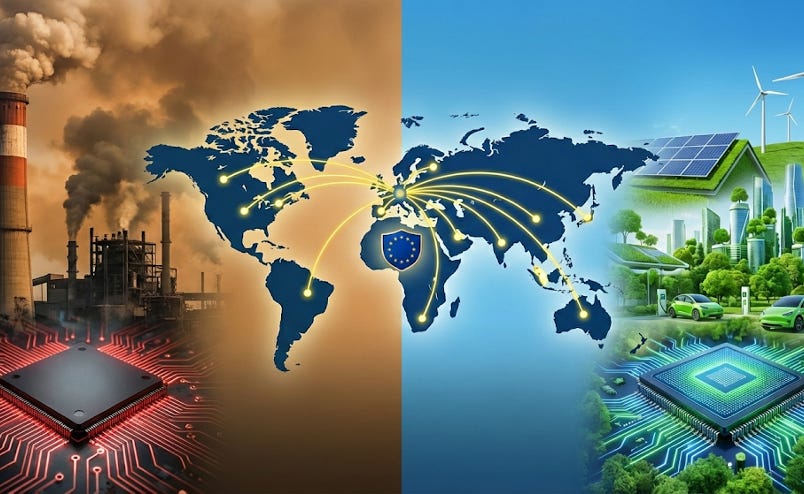
Yet, this sector is experiencing an existential paradox, caught between crucial issues of national sovereignty and alarming environmental impact.
The Geopolitical Challenge: Fragile Sovereignty
The first challenge is one of critical dependence. Nearly 80% of the world’s semiconductor manufacturing capacity is concentrated in Asia (Taiwan, South Korea, China). This hyper-concentration creates a critical reliance for Western nations.
The shortages observed during the COVID-19 crisis merely exposed the vulnerability of these hyper-lean supply chains. Faced with escalating geopolitical tensions, every major region—notably Europe with the European Chips Act—is compelled to develop industrial reshoring strategies to secure technological and economic autonomy. Microelectronics is now a matter of national security.
The Environmental Impact: The Hidden Materiality of the Digital World
The industry also confronts a sustainability crisis. The narrative of digital dematerialization is a myth when faced with its increasing materiality. In France, the digital sector is already responsible for 4.4% of the national carbon footprint (29.5 MtCO2e in 2022), a trend amplified by the energy and material intensity of generative AI.
The microelectronics industry contributes significantly to exceeding the nine planetary boundaries identified by the Stockholm Resilience Center:
Climate Change: Significant greenhouse gas emissions.
Freshwater Usage: Massive industrial consumption. For example, TSMC’s annual water consumption is equivalent to that of a city of 7.5 million inhabitants.
Chemical Pollution: Use of persistent substances like PFAS and potent fluorinated gases.
Biodiversity and Rare Earths: Intensive mineral extraction for materials like rare earths leads to deforestation and territory degradation, directly compromising UN SDGs, particularly SDG 12 (Responsible Consumption) and SDG 15 (Life on Land). The recycling rate for electronic waste currently stands at only 25%.
Furthermore, the value chain for a simple product like a smartphone is of unparalleled complexity. It travels an average of four times around the globe before commercialization, involving raw material extraction across several continents, component manufacturing in Asia, final assembly in China, and global distribution. This geographical dispersion makes the environmental and social traceability of impacts nearly impossible without a rigorous systemic approach.
The Solution Framework: Regulation and Driving Forces
Faced with this monumental challenge, the sector is not without guidance. The Paris Agreement (COP21) and the goal of carbon neutrality by 2050 mandate a decarbonization trajectory. Europe is positioned as a leader with its Green Deal and demanding regulatory framework:
CSRD (Corporate Sustainability Reporting Directive) and VSME: These directives impose reporting based on double materiality, requiring companies to disclose both their impact on the environment and the environmental risks affecting their financial value.
ESPR (Ecodesign for Sustainable Products Regulation): This regulation enforces product eco-design and will introduce Digital Product Passports (DPPs) to ensure full traceability.
PEF Methodology (Product Environmental Footprint): This provides a unified environmental impact measurement standard, expressed in millipoints, facilitating comparison.
The transition is driven by several converging forces such as Regulatory Pressure (CSRD, ESPR) and the demands of key prescribers. Indeed, several digital giants (GAFAM and Hyperscalers) are now imposing strict green requirements on their suppliers, creating a cascading effect throughout the industry. Moreover, finance is also starting to include the imperative of the sustainability transition with investors and funds massively integrating ESG criteria into their capital allocation decisions. From a demand-side perspective also, consumers demonstrate evolving expectations for greater environmental responsibility.
Nevertheless, substantial obstacles remain to achieve this transformation of the semiconductor sector. A still fragmented global regulatory framework, dependence on existing technologies, fear of losing competitiveness, and conservative corporate cultures that resist the necessary paradigm shifts all hinder firms’ ability to enact changes.
Methodology for Enabling the Transformation
It is against this contrasting backdrop that Philippe GILET formulated his thesis’s central research question.
How can a microelectronics SME or Mid-Cap, operating under economic constraints, implement a transformation plan involving its entire ecosystem to embark on the path of sustainability without jeopardizing its position, thereby ensuring long-term growth and resilience?
His thesis proposes a structured three-phase methodology specifically tailored to the realities and limited resources of SMEs and Mid-Caps in the sector. Below is a high-level overview of the phases in his transformation methodology.
Phase 1: Initiating Change (The Diagnostic)
The goal is to establish urgency.
Commitment from General Management
Internal Diagnostic (OPACS analysis) and external analysis (stakeholder study)
Completion of a double materiality matrix
Preparation of an initial VSME Basic report
Prerequisite: Formation of a dedicated team open to change
Phase 2: Optimizing Change (Operational Integration)
The goal is to structure the organization.
Competency building and staff training on sustainability issues
Implementation of an eco-design methodology based on Life Cycle Assessment (LCA)
Transition to the VSME Comprehensive report
Phase 3: Institutionalizing and Sustaining Change (Cultural Embedding)
The goal is to ensure the longevity of the transformation.
Deployment of the 9R strategies of the Circular Economy (Refuse, Rethink, Reduce... Recycle)
Development of a sustainable supplier management program
Implementation of a Balanced Scorecard integrating ESG criteria
Structuring an exploration portfolio for sustainable innovation
Philippe Gilet’s methodology relies on a gradual maturity curve. It prioritizes human support, recognizing that every employee goes through specific psychological stages in adopting change. The philosophy of “start small, think big” respects adoption rhythms while maintaining an ambitious vision for systemic transformation.
Sustainability is no longer an option for the microelectronics industry but a strategic necessity that conditions its growth and resilience in the face of sovereignty imperatives and planetary boundaries. Transformation requires adopting a systemic, measured, and progressive approach, even for smaller enterprises.
If you are interested in applying the framework, you can contact Philippe Gilet here.